

Need Professional Advice?
Our team is here to help you find the perfect setup for your studio or shooting style. 🛍️✨
Get one-on-one guidance from our experts to make the right purchase with confidence.

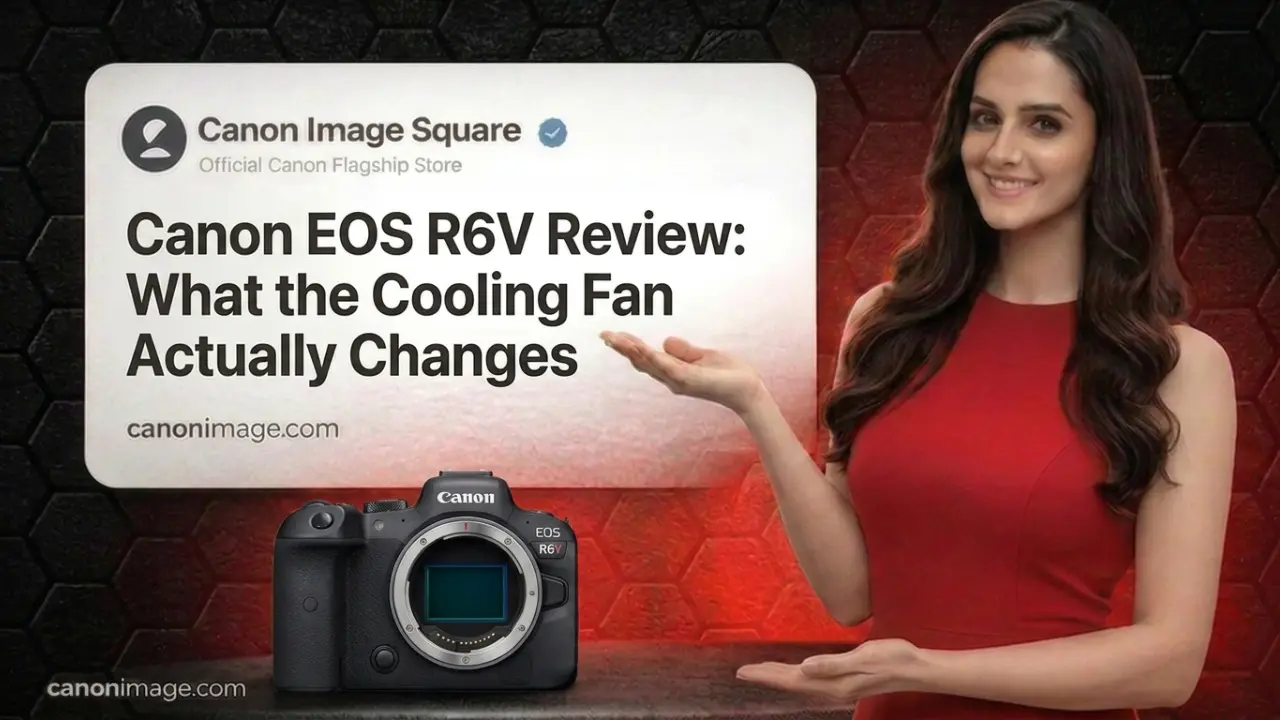
Canon launched the EOS R6 V in India on 13 May 2026, and wrote the name as EOS R6V in its own press material — so if you have seen it spelled both ways, it is the same camera. It arrived alongside the RF 20-50mm F4L IS USM PZ, Canon’s first full-frame power zoom, and the pairing tells you exactly who this camera is for.
The short version: the R6V takes the imaging foundation of the EOS R6 Mark III and rebuilds the body around video. Same 32.5MP full-frame sensor, same 40fps burst, same Dual Pixel CMOS AF II — but with an internal cooling fan, uncropped 4K 120p, and 7K RAW options that the R6 Mark III cannot sustain for as long. If you shoot stills first and video occasionally, the R6 Mark III is still your camera. If long takes are how you earn, read on.
Every hybrid mirrorless camera can shoot impressive video for a few minutes. The problem has never been the codec — it has been what happens at minute twenty, in a room with no air conditioning, in a Mumbai summer, when the thermal warning appears and the camera stops.
Canon’s own figure is that the R6V records 7K Open Gate MP4 for roughly three times longer than the R6 Mark III before thermal throttling. That is not a marginal improvement, and it changes which jobs the camera can take. A wedding ceremony, a conference session, a two-camera interview, a stage performance — these are single continuous takes, and a camera that taps out partway through is not a professional tool regardless of how good the first fifteen minutes looked.
Fans in cameras are not new; Canon put one in the Cinema EOS line years ago. What is new is the fan arriving in a body at this price, in the R6 series, without the size penalty of a dedicated cinema camera.
| Mode | What it is for |
|---|---|
| 7K 30p RAW Open Gate (3:2) | Shoot once, deliver landscape and vertical from the same file. The reason social-first productions buy open gate. |
| 7K 60p RAW Light (17:9) | Full-frame width with headroom to punch in or stabilise in post without losing 4K delivery resolution. |
| 4K 120p uncropped, full AF | Slow motion with the full field of view and working autofocus — not the cropped, manual-focus compromise this usually is. |
| 4K 60p / 30p oversampled | The everyday delivery format, downsampled from more data than it needs, so it is visibly cleaner. |
| 2K / FHD 180p | Extreme slow motion for detail and product inserts. |
Canon Log 2 and Log 3 are both there, along with Canon 709, HDR PQ and HLG. Log 2 is the one to use if you are grading properly; Log 3 if you want something closer to ready out of camera.
The specification that quietly matters most is 4K 120p uncropped with autofocus. On most cameras, high frame rate means a sensor crop, so your 24mm becomes a 35mm, and autofocus degrades or disappears. Getting the full frame and working subject detection at 120p means slow motion stops being a shot you plan around and becomes a shot you can just take.
The “video camera” framing undersells it. The R6V shoots 40fps continuous, has 1,053 autofocus zones for stills with Dual Pixel CMOS AF II and deep-learning subject detection for people, animals and vehicles, and runs 100–64,000 ISO natively with expansion to 102,400.
The 5-axis in-body stabiliser is rated up to 7.5 stops at the centre of the frame with compatible RF lenses. In practice that is the difference between needing a tripod for an interior at dusk and not needing one.
Put plainly: a wedding photographer who also delivers a film could shoot the entire event on this body and not feel short-changed on either side.
| Sensor | 32.5MP full-frame CMOS |
| Processor | DIGIC X |
| Autofocus | Dual Pixel CMOS AF II with deep learning; 1,053 zones (stills), 897 (video) |
| Subject detection | People, animals, vehicles, with face and eye tracking |
| Burst | Up to 40fps |
| ISO | 100–64,000, expandable to 50 and 102,400 |
| Stabilisation | 5-axis IBIS, up to 7.5 stops (centre) with compatible RF lenses |
| Cooling | Internal cooling fan |
| Screen | 3.0in vari-angle LCD, 1.62 million dots |
| Card slots | CFexpress Type B + SD UHS-II |
| Connectivity | Wi-Fi 5GHz/2.4GHz, Bluetooth 5.1, USB-C |
| Battery | LP-E6P |
| Weight | 688g body only |
| India MRP | ₹2,35,995 body, ₹3,55,995 with the RF 20-50mm F4L kit |
Canon sells the EOS R6 V body on its own and as a kit with the RF 20-50mm F4L IS USM PZ. The kit lens is not a throwaway — it is the first full-frame L-series power zoom Canon has made, with three Nano USM motors, two of them driving a motorised zoom that no other full-frame RF lens offers without an external accessory.
Take the kit if you shoot solo and zoom during takes, if you work on a gimbal, or if you want a wide-to-standard L zoom you can leave mounted. Take the body alone if you already own RF glass, or if your work sits at the longer end — in which case the RF 24-105mm f/2.8 L IS USM Z covers more range at a faster constant aperture.
Cards. 7K RAW goes to the CFexpress Type B slot; there is no way around that. The SD UHS-II slot handles proxies, stills and the lighter 4K modes — and there, sustained write speed is the only number that matters. A card with a guaranteed minimum sustained write rate will finish a long take; a card advertising a high peak speed may not. Browse the full memory card range.
Batteries. The R6V uses the LP-E6P, and the fan plus high-bitrate recording draws more power than stills work does. Two spares is realistic for a full day, not cautious.
Storage between shoots. If you keep gear in Mumbai, humidity is a genuine threat to lens elements, and fungus is not covered by warranty. A dry cabinet costs less than one optical service.
Buy the R6V if you shoot long takes for a living — weddings, events, conferences, interviews, worship, education. If you deliver both horizontal and vertical from one shoot and want open gate to do it. If you have been renting a cinema body for jobs your hybrid could otherwise handle.
Buy the EOS R6 Mark III instead if stills are the majority of your work and video is a bonus. You get the same sensor and burst rate, and you are not paying for cooling you will rarely reach the limits of.
Look at the EOS R5 Mark II instead if resolution is what you are short of. 45MP and 8K serve commercial and landscape work that 32.5MP does not.
Do not buy it if you are stepping up from a phone or a kit-lens DSLR. The EOS R8 gives you full frame for far less, and the money is better spent on RF glass at that stage.
A camera this specialised is worth handling before committing. Canon Image Square in Andheri West is an Official Canon Flagship Store with the largest experience zone in West India, so you can mount the R6V next to the R6 Mark III, put the same lens on both, and judge the difference yourself rather than from a table like the one above.
Bring a card and take the files home. All stock is genuine Canon India with full warranty and GST invoicing. Read more about visiting the store in Andheri West, or WhatsApp us your budget and what you shoot, and we will have the relevant bodies ready.
Yes. Canon uses “EOS R6V” in its press material and “EOS R6 V” elsewhere. There is only one camera.
Canon’s MRP is ₹2,35,995 for the body and ₹3,55,995 for the kit with the RF 20-50mm F4L IS USM. Check the product page for our current price.
Any active cooling makes some noise. For dialogue work you should be recording to an external or wireless microphone anyway, which puts the capsule near the subject and away from the camera entirely.
Yes, with a Canon EF-EOS R adapter, retaining autofocus and stabilisation. Our EF lens range is worth a look if you are building a fast kit without paying RF prices.
CFexpress Type B for the 7K RAW modes. SD UHS-II is sufficient for 4K and stills. Ask us which capacity suits your typical shoot length before buying.